DBRS Ratings GmbH (DBRS Morningstar) notes that, on 10 November 2019, the Kingdom of Spain (Spain; rated “A” with a Positive trend by DBRS Morningstar) held its fourth general election in as many years. As widely expected, the election resulted in another fragmented parliament, with Partido Socialista Obrero Español (PSOE) winning most seats in Congress, but still far away from an outright majority. Therefore, compromises will be needed to break the political gridlock and to avoid another hung-parliament.
Main Takeaways from Electoral Results
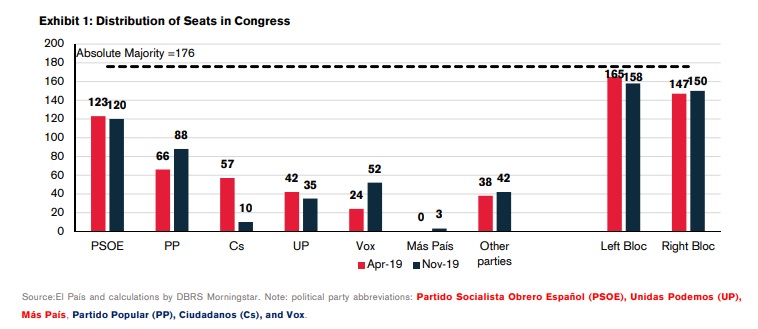
Compared to the previous elections, the so-called left-bloc, comprising PSOE, Unidas Podemos (UP) and Más País (anew party spun off from UP) now has a smaller lead over the right-block that comprises Partido Popular (PP), Ciudadanos (Cs) and Vox (see Exhibit 1). However, the right-bloc remains far from reaching a majority;
There has been a significant rebalancing of forces on the right. PP and the far-right Vox have gained seats at the expense of Cs. With less than 3% of seats, Cs has collapsed and its leader Mr Rivera has resigned. Vox, which finished in third place, seems to have benefited from its strong negative rhetoric on the Catalan situation;
Although the parties in the centre of the political spectrum remain majoritarian, they have lost some ground to the extremes. PSOE, PP and Cs obtained 55.6% of the votes and 62.3% of the seats in Congress this time around, compared to 61.3% and 70.3% in the previous elections in April.
Likely Scenarios for Government Coalitions
DBRS Morningstar views a minority government led by the Socialist Party as the most likely scenario. DBRS Morningstar expects the formation of a new government to still take some time given the elections’ fragmented results and the necessary lead time associated with any coalition negotiations. Whichever form the next government takes, it is bound to remain relatively unstable and require continuous compromise and cooperation to hold up for the whole parliamentary term. Passing the already delayed 2020 budget will constitute the first test for the next administration. This likely instability elevates the risk of snap elections before the end of the parliamentary term.
DBRS Morningstar expects the situation in Catalonia and its political management to remain at the centre of the political debate in the upcoming negotiations to form a coalition government. There are two main scenarios that could allow for a government to be formed, although achieving any of these will require big hurdles to be overcome and compromises to be reached:
Scenarios:
a) PSOE forms a government with the support of UP and Más País. To succeed, it will require additional parliamentary support, potentially coming from the Basque Nationalist Party and the pro-independence Catalan parties. Given the current tensions in the region, even if Catalan pro-independence parties were to support this option in Congress, the minority government would remain unstable.
b) Alternatively, a Socialist-led government is formed without the support of the Catalan pro-independence parties should Cs (or even PP) decide to support PSOE in conjunction with some of the other small parties. In terms of impact on policy, either option would raise the risk of higher public spending potentially financed by higher taxation or some rollbacks of structural reforms. This could exacerbate the ongoing economic slowdown in Spain.
PSOE and PP form a grand coalition that adds up to an absolute majority. DBRS Morningstar assigns a low probability to this scenario. This option might become a reality, if the left bloc fails again to reach an agreement and, as a last resort, the traditional parties attempt to avoid another election or refrain from relying on pro-independence parties.
In terms of policy impact, this could force economic and fiscal policies to veer closer to the centre and strengthen the case for using structural reforms to address Spain’s medium-term challenges.
A hung parliament and another election re-run cannot be excluded. However, due to the electoral fatigue DBRS Morningstar considers this scenario less likely over the short-term. The prospect of a third election in less than a year is expected to prompt political parties to compromise and reach agreements. DBRS Morningstar currently considers that another election in the coming months is unlikely to unlock the stalemate.
Under all these scenarios, DBRS Morningstar expects political parties to respect and operate within the EU fiscal framework, and to maintain the improved trend in the Spanish deficit and debt-to-GDP metrics. DBRS also considers that the still strong support for centrist political parties should continue to prevent radical outcomes. That said, a stable government that decisively addresses the main challenges of Spain, including the ongoing economic deceleration, still high unemployment, pension reform, and the Catalan situation still appears elusive.







 Si (
Si ( No(
No(