Throughout the age of austerity, disinflation and growth stocks were ‘in’; inflation and value stocks were ‘out’. Last November, however, things began to change. The rotation away from the stocks that have been the winners over the past half-decade and into the laggards (energy, materials) may still be in its infancy – but some of the moves have been dramatic.
Might this be the point at which the hitherto successful strategy of being long tech, growth, momentum disruption and growth – and of being short of ‘value’, emerging markets and Europe begins to go into reverse?
2021: Back to the ‘real world?
2021 could prove to be the first year in a long time in which the US tech sector’s long-term secular rate of earnings growth is surpassed by the short-term cyclical growth of, for example, the auto companies – or mining companies, which haven’t been fashionable investments since before the financial crisis…
In the first half of 2020, the pandemic accelerated the adoption of a host of online services. But as 2021 progresses, it seems likely those rates of growth will be hard to sustain, let alone beat, particularly if people begin to spend more time living, socialising and working in the real world – and a little bit less time at home and online.
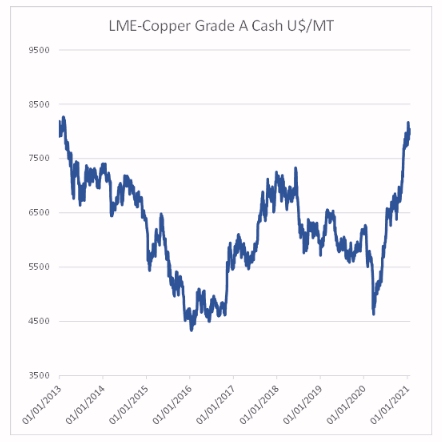
Effective vaccinations against Covid-19 make it feasible that Western economies will start to follow the path charted by Asia, where economic data have given us a tantalising glimpse of a post-Covid future; in parts of that continent, the pandemic is yesterday’s news. China is growing at pre-pandemic speeds again and is sucking in raw materials. The price of copper, the raw material most essential to building the technologically enhanced future based on green energy and EVs, recently raced to a seven-year high.
At the same time, we are conscious that, just as demand for material goods is bouncing back, inventory levels throughout global supply chains are low. Auto manufacturers, for instance, need stainless steel. But with mining projects having been closed or mothballed, steel producers face shortages of iron ore.
As demand comes back and pricing power returns, the effect that operational gearing can have on the earnings of producers in basic industries –such as miners – could be dramatic.
The price of copper – a raw material essential to the ‘green revolution’ – has moved sharply higher
Source: Refinitiv Datastream as at 24 January
But the case for cyclical stocks does not end with a recovery in demand. There is, we believe, another, longer-term geopolitical change at work.
China, de-globalisation and output gaps
The disruptive impact that Covid has had – the way it has accelerated the adoption of new technologies and hastened the end of legacy industries – is well understood. Perhaps less visible has been the way it has accelerated the process of de-globalisation. The world is bifurcating into an economic block dominated by China, a ‘Sinosphere’, and a US-dominated Anglosphere.
China clearly wants to be less dependent on the US as an export market and on US technology; its relative success in controlling the coronavirus has emboldened it in pursuit of that goal. Furthermore, US suspicion of China now seems to be a long-term, geopolitical dynamic – and not merely a symptom of Trumpism.
Our point? As the two powers withdraw from their mutual dependence, supply chains seem likely to become shorter and less closely integrated. That process means more duplication of plants and machinery so, after a decade of capital expenditure being held in check, more capital stock will be required.
That need is particularly acute given that, over the past decade, companies have typically used their excess cash to buy back shares or to de-lever their balance sheets rather than to invest, particularly in sectors such a mining, energy and capital goods.
In an age of inflation…
This retreat from globalisation has consequences for output gaps and so, potentially, for inflation, particularly in prices of goods and raw materials. Since the shock that the global financial crisis delivered more than a decade ago, output gaps across the global economy have been negative – there has been slack in the system, so depriving producers of pricing power.
The system has had the capacity to produce far more steel, more ships – more of everything – than there was effective demand for. But that spare capacity only exists when the economy is viewed in aggregate, global terms. Look at the capacity for the US to produce something – microchips, for example – and the apparent excess may soon become a shortage.
In a de-globalising world, many of our assumptions – such as that the productive capacity of China would act a near-permanent deflationary drag on the world economy may have to be re-examined. We are not there – yet... But it is a discussion that we believe is worth having – and keeping in mind when building a global investment portfolio.








 Si (
Si ( No(
No(